

Professional Floor Levelling Services in Townsville
Floor levelling isn’t one thing — it’s a range of situations and subfloor types, each requiring a different approach. Here’s what we work across. We assess your subfloor accurately, level it correctly, and set every trade that follows up for success.
Floor Levelling in Townsville — The Foundation Every Tiled Surface Depends On
Your tiled floor is only as good as what’s underneath it. That’s just the truth of it. You could spend top dollar on beautiful tiles and hire the most skilled tiler in North Queensland — and still end up with cracked, hollow, and failing tiles within a year, all because the subfloor beneath them wasn’t properly levelled first.
Here in Townsville, this is something we see constantly. Older homes across Kirwan, Hermit Park, Aitkenvale, and Annandale have concrete slabs and timber subfloors that have shifted, settled, and moved with the humidity cycles that come with living in the tropics. And newer builds out in Bohle Plains and Idalia have their own challenges — fresh slabs with surface variation that needs correcting before a single tile goes down.
I WANT A FREE QUOTE ▼
What an Accessible Bathroom Renovation Actually Covers
Concrete Slab Levelling for Tile Installations
Bathrooms, kitchens, living areas — concrete slabs are the most common subfloor type we level in Townsville. We identify high and low points across the full floor plane, grind down any high spots, and apply self-levelling compound to bring the surface to a flat, consistent level ready for tiling. dolor sit amet, consectetur adipiscing elit. Ut elit tellus, luctus nec ullamcorper mattis, pulvinar dapibus leo.
Timber Subfloor Assessment and Preparation
Timber subfloors need a different approach before tiling can happen. We assess the condition and movement of the existing floor structure, install sheet flooring underlayment where required, and prepare the surface so it's stable and flat enough to support a tile system without flex or movement.
Levelling After Removal of Existing Floor Coverings
Pulling up old tiles, vinyl, or carpet almost always leaves something behind — adhesive residue, uneven patches, exposed substrate damage. We assess what's left after the old covering comes up and level the surface correctly before new flooring goes down, rather than tiling straight over an inherited mess.
Spot Levelling of Isolated High and Low Points
Not every floor needs a full levelling pour. Sometimes it's a single low point near a doorway, a high ridge across part of the bathroom, or a localised dip where a drain was previously relocated. We address isolated problem areas with targeted levelling work rather than charging for a full floor pour when it's not needed.
Full Floor Levelling for Whole-Home Tile Installations
When a whole home is being retiled — or a large open-plan area needs a consistent floor level across multiple rooms — we manage the levelling scope across the full installation area. This requires careful planning of compound volumes, priming, and pour sequencing to achieve a consistent result across a large floor plane.
Wet Area Levelling with Falls to Drainage
Bathrooms, laundries, and shower recesses aren't just levelled flat — they need a correctly engineered fall toward the drain. We incorporate the required drainage gradient into the levelling scope while maintaining an acceptably level field across the remainder of the floor, meeting the waterproofing and tiling requirements of a compliant wet area installation.
Serving Townsville Homes Across Every Suburb
Townsville’s housing stock creates a wide range of subfloor conditions — and we work across all of them.
Older homes in the inner suburbs — Hermit Park, Aitkenvale, Annandale, and Mount Louisa — frequently have concrete slabs that have settled unevenly over decades. North Queensland’s humidity cycles cause timber subfloors to move, swell, and shift in ways that don’t happen in southern climates. These homes need subfloor assessment that accounts for what the tropics actually do to building materials over time.
Out in the growth corridors — Bohle Plains, Idalia, and the newer parts of Thuringowa — the challenge is different. Fresh concrete slabs from recent builds often have surface variation that looks acceptable to the eye but won’t support a quality tile installation without correction. A quick level check with a straight edge will tell the story.
Why Subfloor Levelling Cannot Be Skipped
This is the bit that matters most — and it's the part that homeowners and even some builders underestimate until something goes wrong. Tiling over an uneven subfloor isn't a calculated risk. It's a guarantee of problems. Here's exactly what happens when levelling gets skipped or done poorly.
Cracked tiles — when a tile bridges a low point in the subfloor, it has no support beneath part of its surface. Foot traffic flexes the tile across that unsupported span. Tiles crack. It's not a question of if — it's a question of when.
Cracked tiles — when a tile bridges a low point in the subfloor, it has no support beneath part of its surface. Foot traffic flexes the tile across that unsupported span. Tiles crack. It's not a question of if — it's a question of when.
Lippage — this is the height variation between adjacent tiles that creates a stepped effect across the floor surface. Some lippage comes from the laying process, but a significant portion comes from the subfloor being uneven to begin with. It's a tripping hazard and it looks terrible.
Grout failure — tiles that move slightly over an uneven subfloor put constant stress on the grout joints between them. Grout cracks, deteriorates, and opens up — letting moisture in, especially in wet areas where that becomes a waterproofing problem.
Full tile failure — in the worst cases, widespread tile failure across an entire floor requires full removal: tiles, adhesive, and sometimes the levelling work that should have been done properly in the first place. Then it all gets done again — at significant additional cost, and with the inconvenience of having your bathroom or kitchen out of action a second time.
Self-Levelling Compound — How It Works
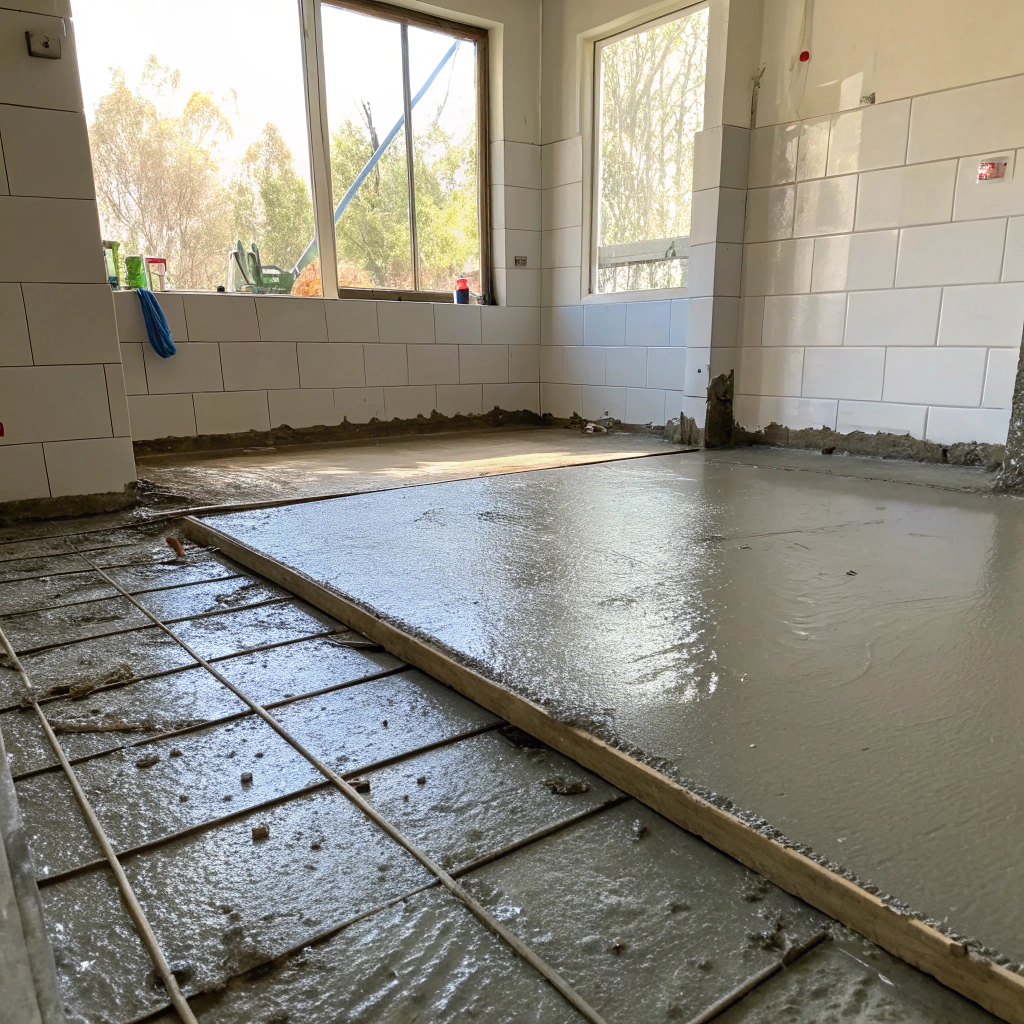
Self-levelling compound is a cementitious product mixed to a pourable consistency. When it’s applied to a prepared subfloor, it flows across the surface and finds its own level — filling low points and creating a flat, even plane across the floor area. It’s an engineered product, not just a bag of stuff you pour and walk away from.
The process goes like this:
- Surface cleaning and preparation — the existing subfloor is cleaned back thoroughly. Any adhesive residue, contamination, or loose material is removed. The compound needs a clean surface to bond to.
- Priming — a bonding primer is applied to the subfloor before the compound goes down. This is one of the steps that gets skipped when the work is done poorly — and it’s one of the main reasons levelled surfaces delaminate and fail. The primer is what creates the bond between the compound and the existing subfloor below it.
- Mixing and pouring — the compound is mixed to the correct consistency for the specific product being used and the specific subfloor type. It’s poured and spread across the prepared area, where it flows to level itself out.
- Curing — the compound needs adequate curing time before tiling commences. Rush this step and the compound hasn’t reached the hardness and stability required to support a tile installation.
- Final level check — before the tiling trade takes over, the levelled surface is checked to confirm it meets the required tolerance for the tile system going down.
Falls to Drainage in Wet Areas
In a bathroom, laundry, or shower recess, the floor has to do two things at once. It needs to be level enough to tile correctly and look right. And it needs to fall toward the drain so water drains off the surface rather than pooling in the corners or sitting against the wall junctions.
Those two requirements — level and falling to a point — have to be managed together, and that’s where the technical skill comes in.
We establish the correct fall gradient toward the drain while keeping the rest of the floor within an acceptable level tolerance for the tile installation. Get the fall wrong and water sits on the floor. Get the level wrong and the tiles look uneven, adhesive coverage is compromised, and you’re back to the problems described earlier.
In shower recesses specifically, the fall needs to be more pronounced — typically steeper than the main bathroom floor — and the levelling work needs to meet the waterproofing requirements for a compliant wet area. The levelled surface has to be stable, fully bonded, and compatible with the membrane system going over the top of it.
What to Expect Working With Us
Subfloor assessment and level survey — we come out, assess the condition of your subfloor, and run a level survey across the floor area. We identify high and low points, assess the subfloor material and condition, and determine what levelling work is required.
Subfloor assessment and level survey — we come out, assess the condition of your subfloor, and run a level survey across the floor area. We identify high and low points, assess the subfloor material and condition, and determine what levelling work is required.
Honest advice and clear quote — we tell you what’s actually needed, not the most expensive version of what could be done. The quote covers product, labour, and any surface preparation required before levelling commences.
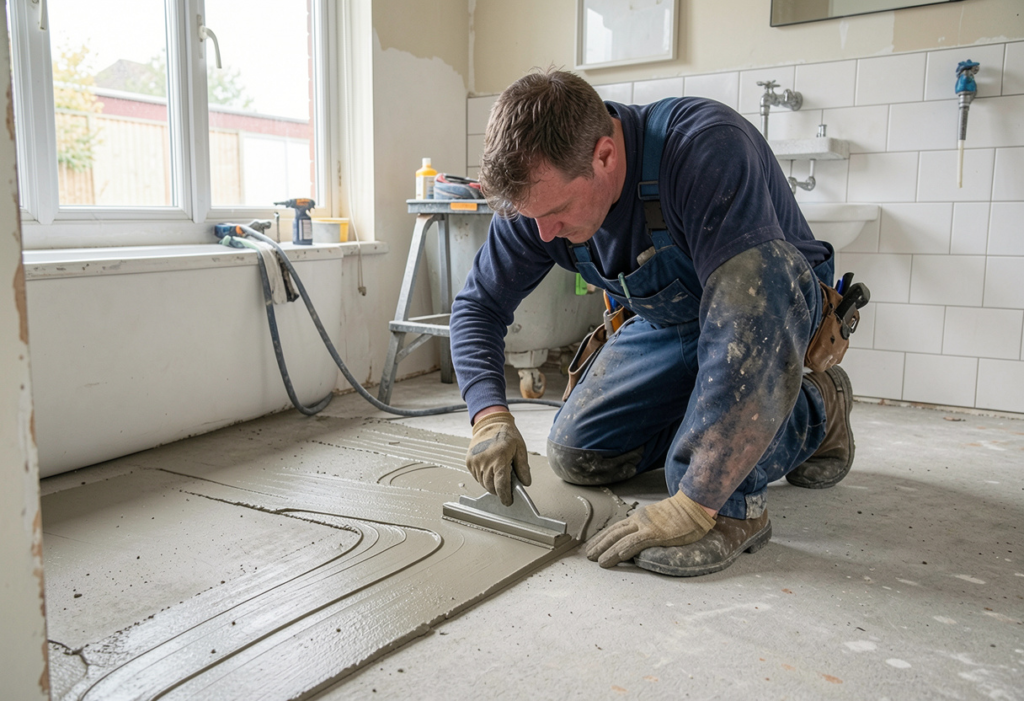
Levelling compound application — compound is mixed, poured, and spread across the prepared area. For wet area applications, drainage falls are incorporated into this stage.
Curing period — we respect the curing time the product requires. Tiling commences when the levelled surface is ready — not before.
Final level check — before the tiling trade takes over, the floor is checked to confirm it’s within the required tolerance. That’s the handover point.
FAQs About Floor Levelling in Townsville
Do we need a full bathroom renovation or just a few modifications?
Most self-levelling compound products are ready for foot traffic within a few hours, but I always recommend waiting a full 24 hours before tiling commences in Townsville conditions. Our tropical humidity can affect curing times depending on the time of year — wet season pours may need a little longer than dry season work. Rushing this step is one of the most common reasons levelled surfaces fail, so I won’t hand the floor over to the tiling trade before it’s genuinely ready. It’s a short wait that protects the entire job above it.
Does Townsville's humidity affect the self-levelling compound?
Yes, it does — and it’s something I factor into every job up here in North Queensland. High humidity during the wet season can slow curing times and affect how the compound flows and settles across the floor. I select products suited to tropical conditions and adjust the application process accordingly, rather than using the same approach you’d take in Brisbane or Sydney. Getting this right is part of what separates a floor levelling job done properly in Townsville from one that’s just following the bag instructions.
Can floor levelling be done in an occupied home?
Absolutely — most of my Townsville jobs are in homes where the family is still living there, especially bathroom and kitchen renovations. The levelling work itself is relatively contained and the curing period doesn’t create major disruption to the rest of the house. I just need the room clear during application and the curing window, which is usually manageable around school hours and work schedules. For FIFO households where timing around roster cycles matters, I’m happy to plan the schedule around when it works best for you.
How do I know if my subfloor actually needs levelling or if it's fine to tile over?
Honestly, the eye test isn’t reliable — a floor can look flat and still have variation that’ll cause tile failure down the track. I use a level survey across the full floor plane to identify high and low points that aren’t visible just from standing in the room. In older Townsville homes especially, slabs that look solid have often settled unevenly over decades without it being obvious until you put a straight edge across them. The free assessment I offer takes the guesswork out of it completely.
Is floor levelling only needed for tiles, or does it apply to other flooring types too?
Floor levelling is most commonly associated with tile installations because tiles are rigid and unforgiving over an uneven surface, but it’s also relevant for vinyl plank and hybrid flooring where the manufacturer’s installation requirements specify a flat substrate. In my experience across Townsville renovations, most homeowners come to me specifically before a tile job — bathrooms, kitchens, and laundries — where the consequences of skipping it are most severe. If you’re laying a softer floor covering with some built-in tolerance for variation, the requirements are less strict, but I’m happy to give you an honest assessment either way. Getting advice before you commit to a flooring product is always the smarter move.
Get a Free Subfloor Assessment in Townsville
If you’ve got a tile installation coming up — bathroom renovation, kitchen update, or a full home retile — the subfloor is where it starts. Get in touch today for a free subfloor assessment and quote.
We’ll come out, take a look at what’s actually going on beneath your floor, and give you a straight answer on what levelling work is needed and what it’ll cost. No obligation, no guesswork.
Call us or fill out the enquiry form and we’ll get back to you promptly to arrange a time that works around your schedule.
